
MONOLITH LAW OFFICE+81-3-6262-3248Weekdays 10:00-18:00 JST
Crypto Assets and Blockchains are decentralized databases created by various IT systems including consensus algorithms, cryptography, and P2P networks that are difficult to alter with a low risk in data loss. As a law firm with expertise in the field of IT, we support businesses that are involved in crypto assets, NFTs, and blockchains.
Crypto assets, NFTs and blockchains are rapidly evolving due to on-going technical innovation and its potential for a wide range of purposes, from fundraising to digital art management. As such, it is also a complex area to regulate by law.
MONOLITH LAW OFFICE is a law firm which has specialized in crypto and blockchain law since its foundation in 2017. We are familiar with the legal regulations of foreign companies, its ventures in Japan, appropriate business guidance towards implementation, and the preparation of documents and contracts for IT-related business operations. Such work requires knowledge and experience in international IT, business, financial legislation, and other legal matters.
We provide sophisticated support for businesses that utilize blockchains, including crypto assets and NFTs, through intricate collaboration between lawyers and IT consultants.
TOPICS
As the business landscape surrounding blockchains and crypto assets evolve rapidly, law firms and attorneys specialized in the field are necessary.
At MONOLITH LAW OFFICE, we have established a dedicated team of lawyers with extensive IT knowledge, internationally qualified attorneys, and experienced IT engineers. Through our robust international network, we foster knowledge, enabling us to stay at the forefront of this dynamic field.

Today, ICO, STO, and IEO, which use crypto assets as a means of fundraising, are rising in popularity. They are viewed as a more flexible way to raise funds than IPOs, etc. while providing investor protection under the regulations of the Financial Instruments and Exchange Act and the Payment Services Act. MONOLITH LAW OFFICE supports in the legality of the business, by providing assistance and preparing reports.

We conduct research on the legality of mining and staking in blockchains, as well as draft contracts and other relevant documents. In some cases, engaging in mining and staking activities in blockchains may require registration as a crypto-asset exchange business. Our expertise lies in understanding the legal requirements and assisting clients in complying with the necessary regulations.

Under the revised Funds Settlement Law, registration as a crypto asset exchange business is now required in order to buy, sell, exchange, and act as an intermediary or agent for crypto assets. By devising a unique business model, it is possible to avoid such registration within this scope of the law. We can also assist our clients with support for registration as a crypto asset exchange and ongoing support for companies operating virtual currency exchanges.

Non-Fungible Tokens (NFTs) are represented by digital art, blockchain game items, etc. Depending on the system, their legal status may differ from cryptographic assets to prepaid means of payment to electronically recorded transfer rights (securities), etc., but they remain subject to complex and strict rules. We are in the business of examining the legality of our clients’ businesses and supporting them from a legal perspective.

The field of blockchains is one in which businesses that use them are evolving at a fast pace, especially overseas. Companies involved in this field must consider if it is possible to implement such a system in Japan based on the latest foreign regulations.
We first read the materials disclosed by such overseas businesses based on our IT knowledge of the latest technologies. Next, we examine the legality of the system in Japan in light of the domestic legal system, including financial legislation, and administrative opinions. We then provide advice on how to legally implement the system in Japan, based on our business judgments.
Blockchain, including crypto assets and NFT, is a complex field that requires law firms and lawyers with a high level of expertise in both IT and law.
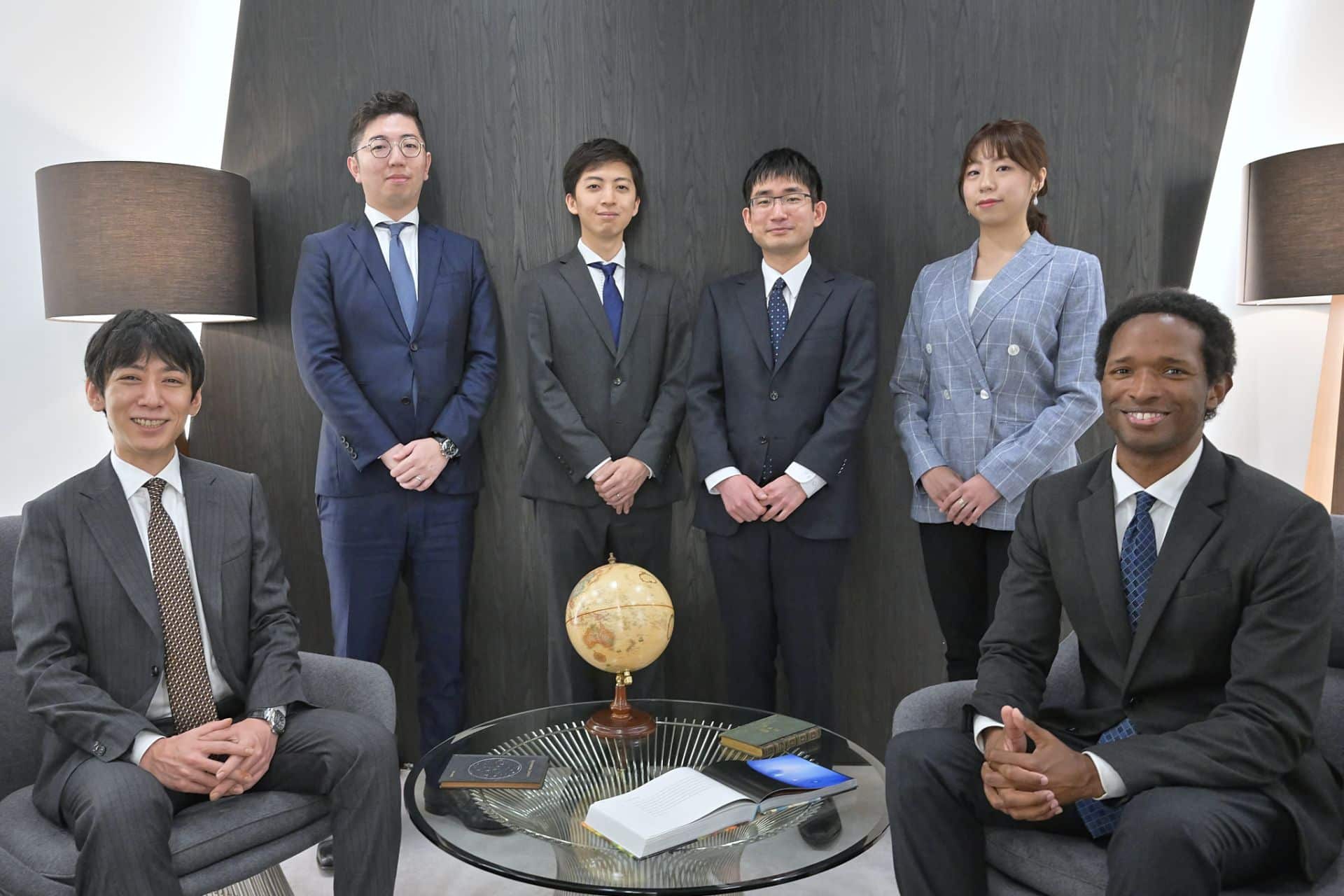
Our firm consists of 30 attorneys and 85 staff members including IT consultants under the supervision of the founder who is a former IT engineer and IT company owner.
Translation and technical understanding of documents published by overseas business owners, as well as technical documents and codes created in-house, are performed by the representative attorney and the IT consulting department. Legal research, contract drafting, document preparation, and other legal services are performed by the representative attorney and the attorney at law. Thus, we can provide a one-stop service for a series of cases that require a high level of expertise in both IT and law.

Non-Fungible Tokens (NFTs), primarily built on the Ethereum blockchain, are being put to practical use to create unique products including digital art, blockchain game items, and trading cards, as well as representing proof of ownership of real property, such as real estate, and memberships in the real world.
NFTs, depending on their design and business scheme, may fall under the category of cryptographic assets, prepaid means of payment, electronic record transfer rights, etc. We support NFT-related businesses with our high level of expertise.

According to the revised Money Settlement Act of 2020, “managing crypto assets for others (i.e., custody business)” is now included within the crypto asset exchange business, requiring registration as a crypto asset service provider and therefore is subject to various regulations in order to implement a scheme that includes management of crypto assets. However, these regulations are very burdensome for those who are not so-called virtual currency exchange services but only provide custody services.
Such services will need to decide as to whether they should register and do business as a crypto asset exchanger or whether they should handle crypto assets while avoiding registration.
Crypto assets and blockchains are technological and business areas that are constantly evolving. This includes regulations over stable coins, which were regulated under the revised Funds Settlement Act of 2022, and IEOs, a funding method that reviews virtual currency exchanges, and staking-related businesses. Our firm keeps up with the latest developments and provides support for such businesses.
As a law firm comprised of a founding lawyer with previous experience as a former IT engineer, along with IT consultants with experience in understanding white papers, technical documents, and other materials released overseas to understand the technology and business models.

Founded by a former IT engineer, MONOLITH LAW OFFICE is a law firm that handles contract drafting, modification, and contract negotiation, as well as dispute resolution when problems arise, not only in the area of crypto assets and blockchain-related matters, but also in various highly specialized system development matters, such as system development for virtual currency exchanges. We also handle dispute resolution when problems arise.

MONOLITH LAW OFFICE handles the creation and revision of documents outlining the terms of use and privacy policies for various apps, services, and games, including those for blockchain games, cryptographic assets and blockchain-related products and services. We also study the existing corporate documents and data, such as requirement definitions for the relevant application development, frameworks created in Adobe XD, LPs, sales materials for prospective customers, etc.
Exchange hacks, investment fraud and insider misappropriation occur across the world, and stolen crypto assets rarely stay where they were taken. Funds that escape immediate freezing move on, looking for an exit at which they can be converted into fiat currency. Japanese crypto asset exchange service providers are one such exit.
For a victim company outside Japan, or for counsel acting on its behalf, the practical question is this: once the funds arrive at a Japanese exchange, what can be done under Japanese law? The answer is that recovery is possible, but the route differs from the one familiar to common law practitioners.
Under Japanese law, a crypto asset is not treated as a “thing” under the Civil Code, and is therefore not subject to ownership. A claim framed as “return of the asset I own” does not work here. What does work is the account holder’s contractual claim against the exchange for the return of the assets held in the account. That claim is attached in much the same way as a bank deposit: the account holder is the debtor, and the exchange is the garnishee. To reach it, the victim must first hold a monetary claim against the account holder, typically in tort or unjust enrichment.
First, Japan has no equivalent of a freezing order against “persons unknown.” The parties must be identified in the application, so on-chain analysis showing that funds reached a particular deposit address is not, by itself, enough. Second, crypto asset exchanges fall outside the statutory procedure by which a judgment creditor may obtain account information from banks. Even after winning at trial, that route is unavailable. Closing this gap is what determines whether recovery succeeds.
Before proceedings begin, the principal tool is an inquiry made through the bar association, by which an attorney may ask a private body to report specified matters. Responses are permitted under the personal data protection framework as disclosure required by law, but they are not compulsory, and practice varies between exchanges and cases. Once proceedings are pending, the court may also be asked to make inquiries or to order the production of documents. Notifying the exchange of the incoming funds may, separately, prompt it to suspend withdrawals under its own terms of service.
Once the account holder is identified, the claim against the exchange is provisionally attached. The application is decided on the documents alone, and the respondent learns of it only when the order is served, which is what makes it effective. The applicant must show a prima facie case and the necessity of preservation, and must provide security in an amount fixed by the court. Importantly, where the asset is located in Japan, a Japanese court may grant provisional attachment even though the substantive dispute is being litigated abroad.
Provisional attachment is an interim measure. If the debtor applies for it, proceedings on the merits must be commenced within the period set by the court, failing which the attachment is revoked. A foreign judgment may be enforced in Japan through an execution judgment, provided the recognition requirements are met, though a foreign freezing order cannot be enforced in Japan as such. Throughout, the account holder remains free to move the funds at any moment. Waiting for the outcome of proceedings abroad before starting in Japan is, in many cases, waiting too long.
MONOLITH LAW OFFICE has long handled matters requiring the identification of anonymous parties, and we accept instructions from victim companies and their counsel outside Japan concerning the tracing and preservation of crypto assets within Japan. We also work directly in English with foreign counsel, which matters here: on-chain analysis reports and contractual records prepared abroad must be reorganised into a form that a Japanese court will accept, and that reorganisation cannot wait until the application is being drafted.