
Key Points of the Amendments to the Childcare and Nursing Care Leave Act Enforced in April and October of Reiwa 7 (2025)
In April and October of Reiwa 7 (2025), the amended “Childcare and Nursing Care Leave Act (Act on Welfare Measures for Workers Engaging in Childcare or Family Care)” and the “Act on Advancement of Measures to Support Raising Next-Generation Children” will be implemented in Japan.
The original purpose of these laws was to prevent the resignation of workers due to life stage changes such as pregnancy, childbirth, childcare, and family care.
With these amendments, the focus is not only on the “leave acquisition system” aimed at balancing work with childcare and nursing care but also on creating an environment for flexible working styles. This includes the expansion and relaxation of existing system requirements and the mandatory implementation of telework for companies. Companies must correctly understand these revisions and appropriately reorganize their internal systems and regulations.
Here, we will explain the key points of the revised Childcare and Nursing Care Leave Act, item by item.
The Purpose and Key Amendments of the Japanese Childcare and Nursing Care Leave Law
The law amending parts of the “Childcare and Nursing Care Leave Law (Act on Welfare Measures for Workers Taking Care of Children or Other Family Members, Including Childcare or Family Care Leave)” and the “Act on Advancement of Measures to Support Raising Next-Generation Children” was enacted on May 24, Reiwa 6 (2024), and promulgated on May 31 of the same year (Reiwa 6 Law No. 42).
The amended law will come into effect in April and October of Reiwa 7 (2025). The 2021 amendment (Reiwa 3) focused on promoting the uptake of childcare leave by men. Although this amendment significantly increased the rate at which men took childcare leave, there remains a substantial gap compared to women.
Reasons cited for men not taking childcare leave include a workplace atmosphere that still makes it difficult to take such leave and business reasons that prevent taking leave. Therefore, it is crucial for companies to work on creating a workplace environment and fostering a culture that facilitates the taking of childcare leave.
On the other hand, the issue of employees leaving their jobs to provide care is a serious problem. Various factors may cause this, including those related to the workplace, family, and care services. However, it is also possible that despite having systems in place to support the balance of work and care, the lack of awareness about the system’s content and usage procedures has hindered its utilization.
Therefore, the Reiwa 6 (2024) amendment obligates measures to effectively balance work with childcare and nursing care for both men and women. These measures include expanding provisions for “flexible working arrangements” according to the child’s age, broadening the obligation to disclose the status of men’s childcare leave uptake, and promoting and strengthening measures to support the next generation and enhance systems to support balancing work and care.
The intent of the system is to support career development by adjusting workloads and work styles without changing roles.
Reference: Ministry of Health, Labour and Welfare | About the Childcare and Nursing Care Leave Law
For a detailed list of the amendments to the “Childcare and Nursing Care Leave Law” and their implementation dates, please see the table below.
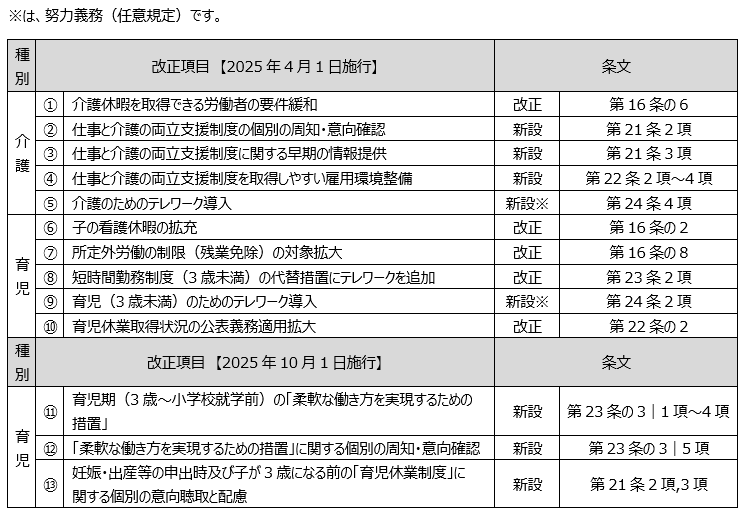
[Enacted in Reiwa 7 (2025)] Five Key Amendments to the Support System for Balancing Caregiving and Work Under Japanese Law
Effective April 1, Reiwa 7 (2025), we will explain the five key points of the amendments related to ‘caregiving’ under the “Child Care and Family Care Leave Act” in Japan.
Easing of Eligibility Requirements for Workers to Obtain Caregiver Leave in Japan
The eligibility requirements for workers to obtain “caregiver leave” have been relaxed in Japan. The exclusion provision that allowed for less than six months of continuous employment under a labor-management agreement has been abolished. Now, workers who are scheduled to work at least two days per week are eligible (there are no changes regarding the employment insurance enrollment period under the Japanese Long-Term Care Insurance System).
Japanese companies that have excluded workers with less than six months of continuous employment from caregiver leave must revise and disseminate their work rules accordingly.
Individual Notification and Confirmation of Intent Regarding the Support System for Balancing Work and Caregiving in Japan
When an employee notifies their employer about facing family caregiving responsibilities, it has become mandatory to provide individual notification and confirm their intentions regarding the support system for balancing work and caregiving. The notification must include information about the following systems, as well as the point of contact for applications, and the employer must confirm the employee’s intentions. It is prohibited to discourage the use of these systems.
1: Caregiving Leave System
- Leave period: Up to 93 days (can be taken in up to three separate instances)
- Eligible family members: Spouse, parents, children, spouse’s parents, and cohabiting grandparents, siblings, and grandchildren who are also dependents
2: Support System for Balancing Work and Caregiving
- Caregiving leave: 5 days per family member per year (up to 10 days for multiple family members), available in half-day or hourly increments
- Reduced working hours system
- Flextime system
- Staggered work hours
- Exemption from overtime
3: Caregiving Leave Benefits System
- Employees who have been enrolled in employment insurance for a total of one year (within the last two years) will receive “caregiving leave benefits (approximately 67% of wages)” during their leave
The method for individual notification and confirmation of intent can be through interviews (online is acceptable) or by providing written documents. However, if the employee wishes, it can also be done via fax, email, or other electronic means (limited to those that can be printed out), such as the company intranet or SNS.
There is no legal specification for the method of notification by the employee, so it can be done verbally. Even if the employee makes a notification in a manner not specified by the employer, the employer must still carry out the measures (individual notification and confirmation of intent). It is prohibited to dismiss or otherwise treat an employee unfavorably for making a notification or because measures have been taken.
Early Provision of Information on Systems Supporting the Balance of Caregiving and Work
It has become mandatory to provide information about support systems for balancing caregiving responsibilities at the time one becomes a Category 2 insured person under the Japanese Long-Term Care Insurance system (from the fiscal year when one turns 40 until one year after reaching the age of 40).
In addition to the 1) Care Leave System, 2) Support System for Balancing Caregiving, and 3) Care Leave Benefits System, it is also required to provide information about where to submit applications.
Furthermore, it is advisable to raise awareness about the Japanese Long-Term Care Insurance system itself (the system used by care recipients).
This provision of information does not need to be done individually, but since it is mandated regardless of whether employees make a request, it is necessary for employers to be aware of their employees’ ages.
The method of providing information can be freely chosen by the employer and includes options such as interviews (online interviews are acceptable), handing out written materials, fax, email, and other means (such as social media and the company intranet), with the note that emails and similar methods do not require a printed document.
Creating an Employment Environment Conducive to Acquiring Caregiving Support Systems in Japan
Employers in Japan are mandated to implement at least one of the following measures to create a workplace environment that facilitates the use of caregiving leave and caregiving support systems (selective mandatory measures).
It is desirable to implement these measures as broadly as possible without limitations.
- Conducting training on caregiving leave and caregiving support systems
- Establishing a consultation system for the above (setting up consultation desks)
- Collecting and providing case studies on the acquisition and use of the above
- Raising awareness of policies promoting the acquisition and use of the above
Implementing Telework for Caregiving Purposes
Employers in Japan are now obligated to make efforts to allow workers who provide caregiving to choose telework as an option.
The specific design of the telework system (such as the frequency and scope of use) can be freely determined by the employer.
When implementing telework measures, employers are not required to reassign workers engaged in tasks unsuitable for telework to positions that are telework-compatible or to create new job categories that can accommodate telework.
Key Points of the Childcare Leave System Reform Enacted in Reiwa 7 (2025)

We will explain the key points of the five items related to the “childcare-related” amendments to the “Childcare and Nursing Care Leave Law” that will be implemented on April 1, Reiwa 7 (2025). Amendments that will be enforced on October 1 will be discussed later.
Expansion of Childcare Leave Benefits
The eligibility for “Childcare Leave” in Japan has been expanded.
In addition to the existing reasons 1: illness or injury and 2: vaccinations and health check-ups, two new reasons have been added: 3: school closures due to infectious diseases, and 4: attendance at entrance or graduation ceremonies. Consequently, the name has been changed to “Childcare and Other Related Leave.”
The range of eligible children has been extended to include those up to the third grade of elementary school (previously before elementary school enrollment), and the exclusion provision for continuous employment of less than six months under a labor-management agreement has been abolished. Now, workers who are scheduled to work at least two days a week are eligible for this leave.
The number of days that can be taken remains the same as the current system (up to 5 days per year for one child, and up to 10 days for two or more children, with half-day leave also available), and the leave continues to be unpaid.
Expansion of Eligibility for Overtime Exemption in Japan
The scope of workers eligible for overtime exemption in Japan has been expanded to include those raising children who are not yet of elementary school age (previously under 3 years old).
When such workers request it, unless it impedes the normal operation of the business (and reasonable efforts should be made), they cannot be required to work beyond their prescribed working hours.
Incorporating Telework as an Alternative to the Short-Time Working System for Childcare (Under 3 Years Old)
When it is difficult for an employer to implement the childcare short-time working system for a worker who has requested it, due to the nature of the work, it is mandatory to conclude a labor-management agreement with exclusion provisions and take alternative measures.
In addition to the conventional options of 1: measures similar to the childcare leave system (unique systems established by the company), 2: staggered working hours, 3: flextime system, and 4: establishing in-house childcare facilities, employers are now obligated to implement 5: the option of telework as an alternative measure.
Implementing Telework for Childcare (Under 3 Years Old)
Employers in Japan are now obligated to make efforts to allow workers raising children under the age of three, including those on reduced working hours, to choose telework options.
The specific design of the telework system (such as frequency and scope of use) can be freely determined by the employer.
In implementing telework measures, employers are not required to reassign workers engaged in tasks unsuitable for telework to positions that are telework-compatible or to create new telework-compatible positions.
Expansion of Obligation to Disclose Paternity Leave Acquisition Status Under Japanese Law
Under the “Act on Advancement of Measures to Support Raising Next-Generation Children,” the obligation to disclose the status of paternity leave acquisition has been expanded to include employers with a constant employment of more than 300 workers (previously over 1,000), and the effective period of the Act has been extended by 10 years (currently until March 31, 2025 (2025年3月31日)).
Starting from April 2025, a new “Childcare Benefit System” will be established, which will provide additional payments such as “Post-Birth Leave Support Benefit (13% of the daily wage at the start of leave, capped at 80% when combined with the Childcare Leave Benefit)” and “Childcare Short-Time Work Benefit (10% of the daily wage during reduced working hours)” (Article 61 of the Employment Insurance Act). This is expected to increase the uptake of paternity leave and reduced working hours among men, which could potentially exacerbate the labor shortage.
To address these issues, it will be necessary to eliminate the personalization of work, distribute tasks, and create an environment where work can be carried out by substitutes. Furthermore, by eliminating unnecessary tasks and promoting digital transformation (DX), it is possible to maximize the use of limited human resources.
Key Points of the Childcare Leave System Revisions Enacted in Reiwa 7 (2025)

Let’s explain the three key points of the amendments related to “childcare” in the “Childcare and Nursing Care Leave Law,” which will be enforced on October 1, Reiwa 7 (2025).
Measures to Realize Flexible Working Styles During Childcare Period (Ages 3 to Pre-Elementary School)
Employers are obligated to implement at least two of the following measures (selective mandatory measures) for workers raising children during the childcare period (ages 3 to pre-elementary school), after understanding the needs of the workplace. Workers can choose one of these systems:
- Staggered working hours or flextime system
- Establishment and operation of childcare facilities
- Reduced working hours system (working with a principle of 6 hours per day)
- Telework (more than 10 days per month)
- Granting of support leave for balancing childcare (more than 10 days per year | unpaid)
Digitalization is crucial for attendance management. It streamlines the management of working hours, allows for accurate data collection, and facilitates real-time understanding of situations for swift responses.
Individual Notification and Intention Confirmation Regarding Measures to Realize Flexible Working Styles
Employers are obligated to individually notify and confirm the intentions of workers regarding the above measures.
Individual Intention Hearing and Consideration Upon Notification of Pregnancy, Childbirth, etc., and Before the Child Turns 3 Years Old
Employers are obligated to hear and consider individual intentions on the following matters when 1: notified of pregnancy, childbirth, etc., and 2: during the year leading up to one month before the child’s third birthday:
It is necessary to individually hear the worker’s intentions regarding the following matters for balancing work and childcare according to the child’s and each family’s circumstances:
- Working hours
- Work location
- Adjustment of workload
- Duration of use of support systems for balancing work and childcare
- Working conditions
When considering intentions, it is required to examine them according to the company’s situation. Note that while the notification of pregnancy, childbirth, etc., is based on the worker’s request, the hearing and consideration during the year leading up to one month before the child’s third birthday must be conducted regardless of any request.
It is prohibited to dismiss or otherwise treat workers unfavorably for making a request or for measures being taken on their behalf.
Conclusion: Consult an Attorney Regarding Measures for the Amendments to the Japanese Childcare and Nursing Care Leave Act
We have explained the key points of the amendments to the Japanese Childcare and Nursing Care Leave Act and the measures that employers should take. Employers are faced with a wide range of responsibilities, including revising work regulations, renegotiating labor-management agreements, explaining the system to employees, and managing applications.
To prepare for such situations, it is crucial to gather necessary information early on and establish a system that allows for smooth responses. If you have any questions about the measures for the amendments to the Japanese Childcare and Nursing Care Leave Act or labor issues, we recommend consulting with an attorney.
Guidance on Measures by Our Firm
Monolith Law Office is a law firm with high expertise in both IT, particularly the internet, and legal matters. Our firm supports a wide range of clients, from Tokyo Stock Exchange Prime-listed companies to venture businesses, in human resources and labor management, as well as in drafting and reviewing contracts for various cases. For more details, please refer to the article below.
Areas of Practice at Monolith Law Office: Corporate Legal Affairs for IT & Venture Companies
Category: General Corporate
Tag: General CorporateIPO
Related Articles



Termination of Employment Contracts under Japanese Labor Law: A Legal Analysis of Mutual Termina.
General Corporate


Reducing the Burden of Proof for Victims of Piracy: Explaining the Copyright Law Amendment Enact.
General Corporate

What is the GDPR? Explaining the Comparison with the Japanese Personal Information Protection La.
General Corporate