
The History of 'Legal Cheating' in Formula 1 – The Endless Battle of Geniuses Over Loopholes in the Rulebook


Are you aware of the other battle that takes place behind the glamorous world of F1? It’s the intellectual struggle over “rule interpretation” between genius engineers and the FIA (Federation Internationale de l’Automobile), the governing body that sets the rules.
No matter how detailed the rulebook is, there will always be room for interpretation, the so-called “grey areas.” Engineers strive to exploit these gaps to develop machines that are “legally cunning.” A prime example is the ‘flexible wing,’ which intentionally bends with the force of the wind to reduce air resistance and run faster without waste, thereby improving times.
This article will explain the history of the technical and regulatory tug-of-war over ‘flexible wings’ from a legal professional’s perspective. Understanding the battles over the rules will make watching F1 even more exciting.
Enhanced Flexible Wing Regulations to be Reinforced Again in 2025
The Spanish Grand Prix held at the end of May 2025 saw Oscar Piastri (of McLaren) take the checkered flag, finishing 2.471 seconds ahead of teammate Lando Norris (also of McLaren), securing his fifth victory of the season with a pole-to-win performance.
While the championship rivalry between teammates at the prestigious McLaren team captured attention, the Spanish GP also highlighted a significant technical development.
This was the FIA’s reinforcement of the front wing test regulations. In the twilight years of the existing regulations before the major regulatory overhaul in 2026, as teams’ understanding of current technology matured and competition for aerodynamic performance intensified, there were suspicions that several teams were advancing designs in a ‘grey zone’ by exploiting the flexibility of the wings.
What Does the Revision of Article 3.15 of the Technical Regulations Entail?
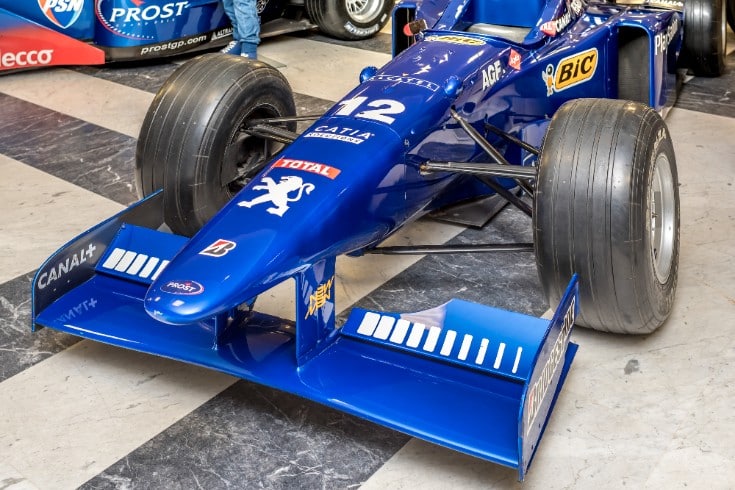
The background leading to the mid-2025 season revision of the Technical Regulations began with the FIA’s decision to install cameras on all teams’ cars during the series of races following the Belgian GP in the latter half of the 2024 season, to closely monitor aerodynamic behavior. As a result, it was determined that the existing regulations were insufficient, in other words, there was a possibility that the wings were varying beyond the permitted limits. Consequently, Article 3.15 of the 2025 Technical Regulations was revised.
3.15.4 Front Wing Bodywork Flexibility
The flexibility of the Front Wing Bodywork will be tested by applying a load of [0, 0, -1000]N at points [XF, Y, Z] = [-800, ±800, 250] or [-1000, ±800, 250]. The load will be applied in a downward direction using a 50mm diameter ram on a rectangular adaptor measuring 350mm in the X-direction and 150mm in the Y-direction. This adaptor must be supplied by the team and should:
a. Have a flat top surface without recesses.
b. Be fitted to the car so as to apply the full load to the bodywork at the test point and not to increase the rigidity of the parts being tested.
c. Be placed with the inner face 725mm from Y=0.
d. Be placed with its forward face at XF=-1100mm.
e. Be placed with its top face at Z=250.
f. Have a mass of no more than 2kg.The deflection will be measured relative to the survival cell and along the loading axis. When the load is applied symmetrically to both sides of the car, the vertical deflection must be no more than 15mm. When the load is applied to only one side of the car, the vertical deflection must be no more than 20mm.
Article 3.15.4 previously stipulated that the allowable deflection when a 100kg load was applied to both sides of the front wing was 15mm, and when the load was applied to one side, it was to be kept within 20mm. With the recent changes, these deflection allowances have been reduced to 10mm and 15mm, respectively.
“3.15.5 Front Wing Flap Flexibility”
“Under the regulations, any part of the trailing edge of a front wing flap may deflect no more than 5mm, measured along the loading axis, when a 60N point load is applied perpendicular to the flap.”
[Guidelines | FIA](https://www.fia.com/regulations)
Furthermore, Article 3.15.5 has reduced the allowable deflection of the wing flap’s trailing edge from 5mm to 3mm.
“Enhanced Flexibility Testing for Rear Wings Under Japanese Motorsport Regulations”
3.15.17 Rear Wing Mainplane Tip Flexibility
The gap between the two sections of RV-RW-PROFILES and RV-RW-TIP, located inboard of Y=525, must not exceed a 2mm variance when two loads of [0,0, -750]N each are applied solely to the forward-most section of the Rear Wing Profile. These loads will be placed at [XR=330, ±525, 910]. The application of the loads requires adaptors, provided by the Competitor, positioned between 490mm and 610mm from Y=0, with each side having a maximum plan view area of 15000mm². The top surface of each adaptor must be at Z=910. At no point may the adaptors make contact with the rearmost profile of the Rear Wing Tip; their design must permit attachment and detachment exclusively through vertical (Z-axis) movement.
In addition, the regulations for rear wings have been revised under Article 3.15.17 in Japan, progressively reducing the allowable slot gap change when a 75kg load is applied from 2mm to 0.5mm.
These enhanced tests are conducted sporadically throughout the season. They may take place under parc fermé conditions, after qualifying or the final race, to prevent teams from exploiting loopholes by switching between test and race wings. The tests are carried out ‘randomly’ to seal off such escape routes.
Regarding this series of revisions, Nicholas Tombazis, the Head of Single-Seater Matters at the FIA, explained that the need to maintain the integrity of the regulations arose against the backdrop of a narrowing technical gap between teams, which is a rare occurrence in recent years, and the increasing suspicions among teams as the competition continues to be closely contested.
What Exactly Are Flexi-Wings in Formula 1?
Firstly, what exactly is the issue with “flexi-wings” in Formula 1? This is not a recent problem but one with a very long history. Flexi-wings refer to wings that are intentionally designed to be flexible in order to enhance aerodynamic performance.
As the car speeds up, the flexing of the wing changes, creating downforce (the force that presses the car to the ground) in corners entered at low speeds, which improves grip. Conversely, on straight sections where high speed is necessary, the wind pressure causes the wing to bend, reducing air resistance and allowing for more efficient acceleration, which contributes to shorter lap times.
While all parts of an F1 car have a certain degree of flexibility due to the nature of the materials, wings in particular can be designed to alter their aerodynamic behavior in response to driving conditions.
The controversy over this flexibility has been a battle of wits, typical of Formula 1, about how to interpret the “boundary between legal and illegal.” Designers have scoured the rulebook and taken into account the inspection methods of the FIA to seek out designs that are “legally cunning.”
The Intensifying Aerodynamic Development Race from the 1990s to the 2000s
The evolution of flexible wings has been like a serialized drama spanning several seasons, at times featuring battles as heated as those between drivers themselves. This story begins with a new phase in aerodynamic technology that Formula 1 entered towards the end of the 1990s.
At that time, automobile manufacturers began participating in F1 as full-fledged works teams, intensifying competition between companies. They poured vast amounts of money into research and development, successively creating new technologies. It was not uncommon for annual budgets for aerodynamics and engine development to reach the order of 10 billion yen. Some teams attempted to design their rear wings to tilt backwards during high-speed runs, aiming to achieve a balance between straight-line speed and cornering performance.
Between 2005 and 2006, a structure emerged that allowed the gap between the wing flaps and the main plane to automatically close through airflow and flexing. This design reduced air resistance on the straights and maximized downforce in the corners. However, the FIA mandated the installation of separators starting from the 2006 Canadian Grand Prix as a countermeasure.
Innovative Aerodynamic Development by the Genius Adrian Newey and Red Bull

And so, in the early 2010s, Red Bull Racing re-emerged as a protagonist on the stage.
The Red Bull Racing’s 2010 F1 car, the “RB6,” designed by the aerodynamic genius Adrian Newey, not only passed the static load tests but also featured a structure where the outer edges of the front wing would sink towards the ground during the race. This was made possible by the application of a special carbon composite material that maintained rigidity up to a certain load and flexed beyond that.
With the RB6, Red Bull Racing secured pole position in 15 out of the 19 races of the 2010 season, showcasing a speed in qualifying that overwhelmed their competitors. Ultimately, the team achieved an overwhelming success by winning both the Constructors’ and Drivers’ Championships for the first time since their inception.
At that time, the FIA Technical Regulations (2010 edition) stipulated in Appendix 3, Article 3.17 that “the front wing must not deflect more than 10mm under a load of 100kg,” but this was limited to static conditions. Red Bull passed this test while still managing to induce an “sinking” aerodynamic effect during actual racing.
In other words, they employed a highly challenging approach that adhered to the “letter” of the rules while circumventing their “intent.” This optimized downforce and airflow to the floor, particularly improving the efficiency of air intake from the bottom of the side pods to the diffuser dramatically.
Despite numerous protests from rival teams, the FIA deemed the design “legal” in light of the then-current Technical Regulations. It was a moment that set a precedent: a machine designed within inspection standards was recognized as legal, as it did not violate the “letter” of the rules. However, it also signaled the beginning of further regulatory tightening.
Thus, the evolution of the flexible wing has been a cycle of innovation by the teams and reactive measures by the FIA.
The Era of Insufficiency in Merely Adhering to the ‘Letter’ of the Rules: A Shift in Precedent?
Just when it seemed that the battle over static testing had settled, tensions between the FIA and Red Bull escalated once again. Red Bull’s next move involved an aerodynamic device known as the ‘blown diffuser.’ This ingenious system strategically directed exhaust from the engine onto the diffuser, thereby increasing the downforce at the rear of the car.
In response to this tactic, the FIA revisited the aforementioned ‘precedent’ and began to address the issue by introducing the concept of the ‘spirit of the rules’—
In the next article, we will take a closer look at how the FIA responded to the blown diffuser, how they ultimately deemed it ‘illegal,’ and what technical and legal interpretative differences were involved.
Guidance on Measures Provided by Our Firm
Monolith Law Office is a law firm with high expertise in both IT, particularly the internet, and legal matters. Our firm supports a wide range of clients, from Tokyo Stock Exchange Prime-listed companies to venture businesses, in human resources and labor management, as well as in drafting and reviewing contracts for various cases. For more details, please refer to the article below.
Areas of Practice at Monolith Law Office: Corporate Legal Services for IT & Startups

Category: General Corporate
Related Articles


Can an Employment Contract's Non-Competition Obligation Prohibit a Job Change to a Competitor?
General Corporate



Explaining Major Amendments to China's "Cybersecurity Law": How Should Companies Respond to Toug.
General Corporate

What is Fundraising through Stock Acquisition Rights in Seed Investment by J-KISS (Japanese KISS.
General Corporate

Comprehensive Explanation of the Duty of Care and Legal Liability in Nursing Care Accidents
General Corporate