
Navigating Safety and Rules: A Legal Examination of Tsunoda's Red Flag Overtake Penalty at the F1 Canadian GP

Formula 1 is always a balance between safety and competitiveness. However, there are times when a driver’s instinctive decision-making directly clashes with the written rules. This was the case with the penalty imposed on Yuki Tsunoda of Oracle Red Bull Racing during the 2025 F1 Canadian Grand Prix (10th race).
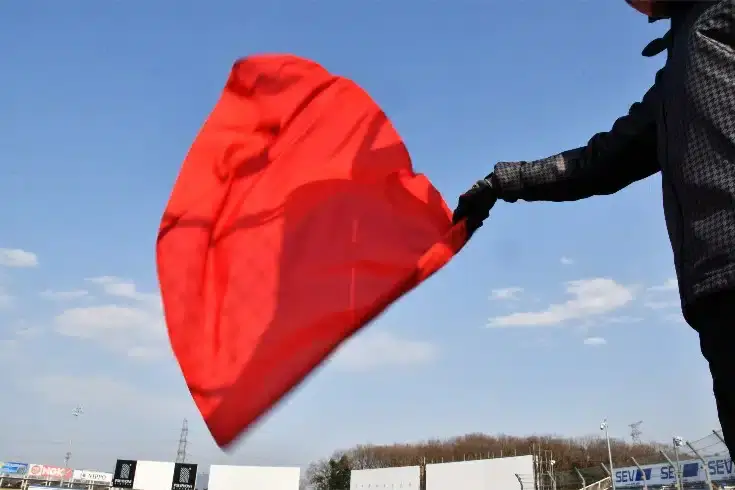
In F1, a ‘red flag’ is displayed when a major accident occurs or when there are dangerous obstacles on the track. While the red flag is displayed, overtaking is prohibited, and drivers are required to return to the pits. However, Tsunoda overtook a damaged car, leading to a strict penalty from the FIA. Behind this decision lies the philosophy of stringent safety management in F1 and the application of supporting rules.
In his subsequent comments, Tsunoda argued that “it was a decision made to avoid danger amidst flying debris,” explaining that he deliberately chose to overtake as a safety precaution. Was this decision a violation of the rules, or was it a legitimate self-defense measure? Let’s focus on safety and discipline in F1 and analyze the legal background and the validity of the ruling in this case.
The Background of the 10-Grid Demotion Penalty

In the 2025 F1 Canadian Grand Prix, the 10th race of the season, driver Yuki Tsunoda was handed a severe penalty: a 10-grid demotion in the final race, meaning his starting position was moved back by ten places. Generally, in F1, the starting position is considered crucial, and starting from the back of the grid makes aiming for a podium finish (top 3) exceedingly difficult.
The incident in question occurred during the third free practice session (FP3). McLaren’s Oscar Piastri made contact with the barrier at the exit of turn 14, resulting in a punctured right rear tire and suspension damage. This led to the session being temporarily halted with the display of the red flag.
At that time, Tsunoda was driving near turn 6 and maintained his speed after the red flag was displayed, approaching Piastri’s car. According to post-race data, while Piastri was traveling at a speed of 86 km/h, Tsunoda approached at 171 km/h and overtook him.
In a subsequent hearing, Tsunoda explained that he overtook to avoid the hazards of the damaged car and debris on the track, but the stewards (officials supervising the competition) deemed this inappropriate. The speed and condition of Piastri’s car were not considered sufficient justification for the overtake.
Tsunoda stated, “There was a risk of debris flying from Piastri’s car, which was starting to lose its right rear tire, and I overtook after ensuring the safety of my surroundings. I saw Oscar on the left side, and I understand that overtaking is not allowed under a red flag. However, waiting behind the damaged Piastri’s car to pit felt like waiting to be hit by debris,” and he argued that it was “a ridiculous penalty.” While there were opinions on the internet agreeing with him, there are also persistent remarks that this shows a lack of understanding of the rules.
The Red Flag: An ‘Absolute Rule Without Exceptions’
The basis for this penalty is found in Chapter 2, “Event Operations Procedures,” Article 2.5.4.1 b of the FIA International Sporting Code Appendix H (Appendix H). The original text is stipulated as follows:
b) 1) When a red flag is displayed, all vehicles must immediately reduce speed and return to the pit lane slowly. Overtaking is prohibited.
3) In addition to the prohibition of overtaking, drivers must be aware that race vehicles and service vehicles may be present on the track, that the circuit may be completely blocked due to an accident, and that weather conditions may make it impossible to drive at racing speed on the circuit.
Translation of FIA International Sporting Code Appendix H
The intent of this regulation is based on the premise that, at the moment the red flag is displayed, not all drivers can immediately grasp whether the accident site and its effects extend across the entire course.
In other words, the red flag is a “declaration of an emergency situation where situational awareness is difficult,” and it is unclear where vehicles or debris have stopped, whether marshals (track officials) are working, or even if emergency responses are underway. Overtaking in such circumstances carries the risk of unpredictable secondary accidents or personal injury, hence it is established as an ‘absolute rule’ that, in principle, allows for no exceptions.
Driver Tsunoda was given a 10-grid position penalty in addition to 2 penalty points being added to his record. This brings his total accumulated penalty points to 2 over the past 12 months.
The penalty points system in Formula 1 is one of the means by which the FIA monitors sportsmanship and safety, and if a driver accumulates 12 points within 12 months, a severe sanction of suspension from the next race is imposed.
The Discretion and Limits of the FIA from a Legal Perspective

Acts of overtaking under a red flag, as in this case, should in principle be strictly enforced as an “immediate violation.” However, the judgment involves a degree of factual determination and interpretation. Factors such as the behavior of the overtaken vehicle, its direction of travel, positioning on the course, and the level of safety are taken into account, ultimately leaving the decision to the discretion of the stewards.
If the “overtaking for safety” claimed by driver Tsukada was indeed factual and reasonable, theoretically, the option to limit the response to a warning or a minor penalty could have been considered. However, in this instance, after comprehensive consideration of telemetry, video footage, and the condition of each vehicle, the stewards processed it as a “clear violation.”
Summary: The Relationship Between Drivers and Regulations
Formula 1 is a sport where creativity and judgment within limits are essential, and the application of rules is also a series of intricate legal decisions.
The case of driver Tsunoda serves as an excellent example of the grey area between the “letter of the rules” and “on-the-spot judgment during a race.” While clearer operational standards for overtaking during a red flag may be presented in the future, drivers currently need to re-acknowledge the fundamental principle of an “absolute prohibition.”
In our next article, we will continue with the topic of this article and discuss overtaking during the introduction of the safety car in the same Canadian Grand Prix. Despite similar actions, why was the penalty limited to a reprimand rather than a grid demotion like Tsunoda’s case? We will examine the consistency and legal validity of the FIA’s penalty decisions.
Related Articles: F1 Legal Lab
Guidance on Measures by Our Firm
Monolith Law Office is a law firm with high expertise in both IT, particularly the internet, and legal matters. Our firm provides support in human resources and labor management, as well as drafting and reviewing contracts for various cases, serving clients ranging from Tokyo Stock Exchange Prime-listed companies to venture businesses. For more details, please refer to the article below.
Areas of Practice at Monolith Law Office: Corporate Legal Affairs for IT & Startups

Category: General Corporate
Related Articles

Learning Crisis Management and the Role of Lawyers from the Information Leak at Keio University
General Corporate

What are the Regulations of the Japanese 'Pharmaceuticals and Medical Devices Act' Regarding Adv.
General Corporate