
Explanation of the New System under the Information Distribution Platform Response Law (Amended Provider Liability Limitation Law) Enforced in May of Reiwa 7 (2025)

Infringements of rights on the internet, such as reputational damage and defamation, have become serious social issues. In response to these situations, the “Provider Liability Limitation Law” will be renamed and revised to the “Information Distribution Platform Measures Law” starting from May of Reiwa 7 (2025) to provide effective relief for victims.
The revised law mandates designated large-scale platform operators to establish criteria for post removal and to implement a system for publishing their response status, with penalties also being introduced.
This article will explain the criteria for “large-scale platform operators” who are subject to regulation and the specific obligations under the revised law.
Understanding the “Information Distribution Platform Countermeasures Act” in Japan
The “Information Distribution Platform Countermeasures Act (Act on the Limitation of Liability for Damages of Specified Telecommunications Service Providers and the Disclosure of Sender Information)” is the second major revision since the establishment of the “Provider Liability Limitation Act” in 2001 (Heisei 13). In response to the social issues arising from the infringement of rights on the Internet, a new system has been introduced for “major platform operators,” leading to a change in the name of the law.
In 2021 (Reiwa 3), the burden of legal procedures became a significant concern as many victims started to file “sender information disclosure requests.” To provide swift relief for victims, a non-contentious procedure was established, allowing the disclosure of sender information through a single process. However, challenges such as the “clear infringement requirement” and foreign companies’ terms of service not considering Japanese laws or the actual state of harm were pointed out, indicating that the system was not functioning sufficiently.
The 2024 (Reiwa 6) amendment was designed to voluntarily encourage providers to properly maintain the system. Designated “major platform operators” are now obligated to establish criteria for deletion and to publish their response status, with penalties also being introduced.
The main points of the amendment are as follows:
- Change of the law’s name
- Designation and notification of “major platform operators” (Articles 20, 21)
- Obligation to expedite responses to rights infringement information (Articles 22–25)
- Obligation to ensure transparency of operational status (Articles 21–29)
- Introduction of recommendations and penalties (Articles 35–38)
The information subject to transmission prevention measures (deletion) includes rights infringement and legal violation information. However, considering that government involvement is not appropriate (equivalent to censorship, issues of neutrality), the substantive legal judgments are to be made primarily by the “major platform operators.”
The revision of the “Provider Liability Law” is illustrated as follows:
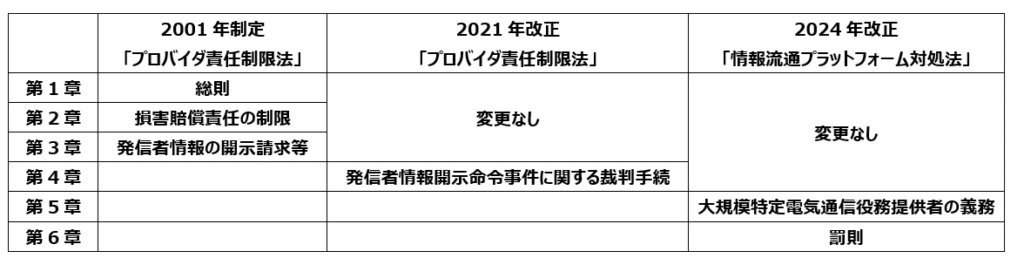
Requirements for Major Platform Operators Under Japanese Law

The requirements for being designated as a “Major Platform Operator” under the Japanese Act on the Regulation of Transmission of Specified Electronic Mail are as follows:
- More than 10 million monthly senders (domestic) and over 2 million monthly transmissions (domestic).
- Technically capable of implementing measures to prevent the transmission of infringing information (deletion).
- Services other than those with a low risk of rights infringement, which are not primarily intended for communication between unspecified users or are provided incidentally to social networking services (SNS) that do not have communication between unspecified users as their primary purpose.
Including foreign companies, those designated as “Major Platform Operators” have an obligation to notify the Minister of Internal Affairs and Communications of Japan (Article 21).
Obligation to Expedite Responses to Infringement Information
Under the new system, obligations imposed on “large-scale platform operators” are divided into two categories: the acceleration of responses to infringement information and measures related to the transparency of operational status.
Below, we will explain the key points of the mandated obligations.
Publication of Methods for Accepting Deletion Requests from Infringed Parties
There is an obligation to establish and publish a contact point for accepting deletion requests from infringed parties. The following points should be considered (Article 22):
- The ability to submit requests online (and to do so in Japanese)
- Not imposing an excessive burden on the requester
- Clearly indicating to the requester the date and time when the request was received
“Not imposing an excessive burden” includes, for example, ensuring that the deletion request form is easy to find, allowing those who cannot obtain an account due to age restrictions to make a deletion request, and taking care to not infringe on privacy or other rights.
Appointment and Notification of “Infringement Information Investigation Specialists”
“Large-scale platform operators” must conduct the necessary investigations related to infringement information without delay when a deletion request is received from an infringed party (Article 23).
To properly handle legal matters related to these investigations, it is required to appoint “Infringement Information Investigation Specialists” who have sufficient knowledge and experience in dealing with rights infringements occurring on the internet.
Specifically, the requirements for “Infringement Information Investigation Specialists” include being a legal professional, such as an attorney, with adequate knowledge and experience in Japanese culture and social issues (limited to natural persons).
The number of Infringement Information Investigation Specialists must be at least one per 10 million average monthly users or one per 2 million average monthly page views. If an Infringement Information Investigation Specialist is appointed or changed, it is necessary to notify the Ministry of Internal Affairs and Communications.
Notification to the Deletion Requester
“Large-scale platform operators” must decide whether to take measures to prevent the transmission of infringement information based on the results of the investigation and notify the requester of the following within 14 days of receiving the request:
- When the infringement information has been deleted, that fact
- When the infringement information has not been deleted, that fact and the reasons for it
If there is a legitimate reason why notification cannot be made within the period, such as the following, notification must be made without delay:
- When it is decided to hear the opinion of the sender of the infringement information for the investigation
- When it is decided to have the investigation conducted by a specialist
- When there are other unavoidable reasons
The Obligation of Transparency in Operational Status

As mentioned above, the traditional ‘clear infringement requirement’ posed challenges, such as foreign companies’ terms of service not considering Japanese laws or the actual state of harm, and concerns about arbitrary deletions by operators, indicating that the system was not always functioning effectively.
To prevent these issues, it is crucial for providers to establish transparent deletion criteria and to respond fairly and consistently. Legislative reforms were deemed necessary to ensure that operators’ voluntary deletions based on terms of service are carried out swiftly and appropriately.
Publication of Criteria for Implementing Deletions
As mentioned above, the information subject to deletion includes rights-infringing information and information that violates laws. However, the substantive judgment on what information (expression) should be deleted is left to the autonomy of “large-scale platform operators.”
Rights-infringing information and information that violates laws correspond to crimes under the Penal Code, but there are differences in expression. Therefore, large-scale platform operators are obligated to establish specific criteria for what constitutes deletable information. The content of the “Criteria for Implementing Deletions” must conform to all of the following:
- Specify the types of information subject to deletion according to the cause of the large-scale platform operator’s awareness of the information’s circulation.
- When implementing “service suspension measures,” specifically establish criteria for carrying out such measures.
- Use expressions that are easily understandable by the sender and related parties.
- Consider consistency with laws that establish a duty of effort regarding the implementation of deletions.
Large-scale platform operators can voluntarily delete information based on their established criteria, but there are exceptional cases where deletion is possible even if not explicitly stated in the criteria:
- When the large-scale platform operator is the sender of the information to be deleted.
- When there is a legal obligation to delete unjust infringement information.
- In cases of emergency necessity for deletion, where the type of information to be deleted could not normally be anticipated and is therefore not specified in the deletion criteria.
The advance notice period for the “Criteria for Implementing Deletions” is up to two weeks before the implementation of the deletion.
Furthermore, once a year, large-scale platform operators must create and publish documents that organize examples of information for which transmission prevention measures have been taken according to the criteria, which will serve as a reference for the sender and other related parties, sorted by type of information.
On the other hand, in a court-requested deletion, the claimant must prove the “clearness of rights infringement (Article 5, Paragraph 1),” which becomes the claimant’s burden.
While the hurdle for a deletion request is not as high as for a request for disclosure of sender information, the Tokyo High Court overturned the first instance decision by affirming the requirement of “clearness of rights infringement,” stating that “forcing the disclosure side to provide proof that is nearly impossible is not appropriate. It does not completely overlap with the judgment of illegal defense in ‘damages claim litigation'” (Judgment on December 9, Reiwa 2 (2020)).
This case is a judgment that does not demand an interpretation of the “clearness of rights infringement” requirement in the “sender information disclosure request system” to the extent that it nullifies the purpose of the system.
Notification Obligations to the Poster upon Content Removal Under Japanese Law
When content is voluntarily or mandatorily removed, there is an obligation to promptly notify the poster of such action and the reasons for it (the relationship between the removal and the removal criteria), or to ensure that the information is readily accessible to the poster in a manner that is reasonable and appropriate for them to become aware of the content’s removal.
Disclosure of Content Removal Status
“Major Platform Operators” in Japan are obligated to disclose the status of content removals via electronic notice once a year, within two months after the end of each fiscal year, based on the obligations mentioned above.
The items that must be disclosed are as follows:
- Receipt status of content removal requests
- Implementation status of notifications in response to content removal requests
- Implementation status of notifications to the content originators when content is removed
- Status of content removal implementation
- Self-assessment regarding the above items
- Items prescribed by the Ministry of Internal Affairs and Communications ordinance as necessary to clarify the content removal status, including self-assessment criteria, and in the event of changes to the evaluation criteria, the content and reasons for such changes
Penalties Under the Japanese Information Distribution Platform Regulation Law

When “Major Platform Operators” violate obligations (Articles 22, 24-28), the Minister of Internal Affairs and Communications may recommend necessary measures to correct the violation.
If the operator fails to take the recommended measures, the Minister of Internal Affairs and Communications can issue an order to enforce them (Articles 30, 31).
Violating this enforcement order can result in imprisonment for up to one year or a fine of up to 1 million yen (Article 35).
Furthermore, “Major Platform Operators” are subject to dual penalties, and in the case of a corporate entity violating Articles 21 or 35, a fine of up to 100 million yen may be imposed (Article 37).
Summary: Anticipated Acceleration of Rights Infringement Responses Through the Revised Information Distribution Platform Regulation Act
We have explained the key points of the newly revised “Information Distribution Platform Regulation Act” in Japan.
For major platform operators, it is necessary to create an internet environment that considers the balance between the “freedom of expression” of the sender and the “relief of victims” whose rights have been infringed upon.
With this revision, it is expected that the response of providers to defamation and reputational damage on the internet will be expedited. For the removal of defamatory posts, please consult with our experienced attorneys.
Guidance on Measures Provided by Our Firm
Monolith Law Office is a legal practice with extensive experience in both IT, particularly the internet, and legal matters. In recent years, information related to reputational damage and defamation spread online has caused serious harm as a ‘digital tattoo.’ Our firm offers solutions to combat the effects of ‘digital tattoos.’ Please refer to the article below for more details.
Areas of practice at Monolith Law Office: Digital Tattoo

Category: General Corporate
Tag: General CorporateIPO
Related Articles

Stock Exchanges and Share Transfers in Japanese Corporate Law: A Guide to Establishing a Wholly .
General Corporate



What is the UK GDPR? Explaining the Relationship with the GDPR and Key Points to Remember
General Corporate


The Relationship Between SaaS Services with Chat and Newsletter Features and the Japanese Teleco.
General Corporate