
An Attorney Explains How to Delete Posts on Host Love (Hosurabu)

Host Love (also known in Japan as “Hosurabu”) is an anonymous online bulletin board specializing in nightlife businesses, such as host clubs and hostess clubs. The website contains a wide range of posts, from reviews of clubs and staff members to general discussions unrelated to the industry.
However, some posts may contain information that constitutes defamation or an invasion of privacy. If you find a post that defames you or discloses your personal information without your permission, you may naturally want it removed as quickly as possible.
As of February 13, 2025, Monolith Law Office has handled more than 300 individual post removal requests and more than 10 requests involving the deletion of entire threads. In many cases, we have been able to resolve such requests within 1-2 weeks (depending on the specific circumstances of each case), heliping clients limit further reputational harm.
In this article, we explain how to request the deletion of posts on Host Love, based on our practical experience. The article is written for readers without legal knowledge, so feel free to read this at your own pace.
Overview of Host Love
Host Love is an anonymous online forum for the nightlife industry. Launched in 2001 as a platform specifically designed for host clubs, it has since evolved to cover various sectors, including hostess clubs, adult entertainment services, and casual discussions. The site attracts more than two million monthly users, and it also features dedicated forums for all 47 prefectures in Japan, reflecting its region-specific structure. (※Usage is not permitted for individuals under 18 years old.)
What constitutes a removable post on Host Love?
You may come across defamatory posts when browsing threads on Host Love. Especially with its localized forum feature, it’s easy to identify who the post is referring to. If it can be shown that a post violates the site’s terms of use or the content is illegal, it may be eligible for removal. There are two types of content that can be subject to removal on Host Love: defamation and invasion of privacy.
Potential defamation
Given the large number of people involved in the nightlife industry, Host Love may contain posts that amount to defamation. For example, there may be defamatory comments posted against co-workers, rival establishments, or competing businesses to damage their reputation. Furthermore, as it is a service industry, there is also the possibility of receiving complaints from customers about how an establishment handled certain situations.
Due to a significant number of users on Host Love, complaints or dissatisfaction expressed about an establishment can directly affect customer traffic. It goes without saying that it is necessary for establishments to take appropriate measures against defamation and reputational harm on Host Love.
Invasion of Privacy
For instance, a regular guest or an obsessive fan of a host may engage in stalking behavior, such as posting photos of the host’s partner on the website. Exposing private information online can often have a significant impact on daily life and work environment.
There is also a risk of employees disclosing customers’ personal information. For example, posts like “I served celebrity XX the other day, but they were stingy,” can cause a significant reputational damage to the customer, especially if the individual is a public figure, such as an idol or actor.
Furthermore, there are cases where corporate executives use the service for entertainment. If posts like “The president of XX company came the other day and told me about his affair” are made, they can undermine employee trust, damage the company’s reputation, and negatively affect sales and overall performance.
How to Remove Posts from Host Love for Violating Terms of Service

The guidelines for requesting removal from Host Love are as follows:
Host Love Removal Request Guidelines
Regarding Personal Names, Addresses, and Affiliations
- Posts intended to identify individuals for the purpose of defamation
- The content is not in the public interest
- Lacks explanation of its purpose
Phone Numbers
Even if they are partially redacted or implied by the context, all phone numbers are subject to removal, except:
- when they are clearly public;
- it can be verified the individual posted the number themselves; or
- the number be confirmed through the linked destination
Email Addresses and Host Information
Posts may be subject to removal only when it is clear that they were aimed at attack with malicious intent, or when it is judged that the purpose is to expose information to the public without any explanation of the purpose. The decision will be made based on the context.
Regarding Defamation
All posts containing information that can identify private individuals (excluding hosts/public figures) are generally subject to removal. However, posts may not be removed if they serve the public interest, are in line with the purpose of the website, or contain factual accounts from those who were directly involved in the matter.
Private Life Information
Information regarding private life that lacks public interest and private information about third parties is subject to removal, even if the post does not contain defamation and does not identify individuals (including hosts and public figures).
As explained above, there are specific criteria for the deletion of posts, and Host Love remove posts only when they are against the website’s terms of use or deletion request guidelines. The term “public interest” means “for the benefit of society in general.” For example, posts intended to damage the reputation of rival establishments are not considered to be of public interest. When submitting a deletion request, it is important to explicitly identify which post violates which section of the terms of use.
How to Request Removal from the Website
Requests for removal from the website can be completed by filling out the removal request form, which can be found by clicking on “> Removal Request” at the bottom of the top page. In the form, you need to fill in:
- The 14-digit number of the target URL (thread)
- The target response number
- The reason for removal (noted from the guidelines)
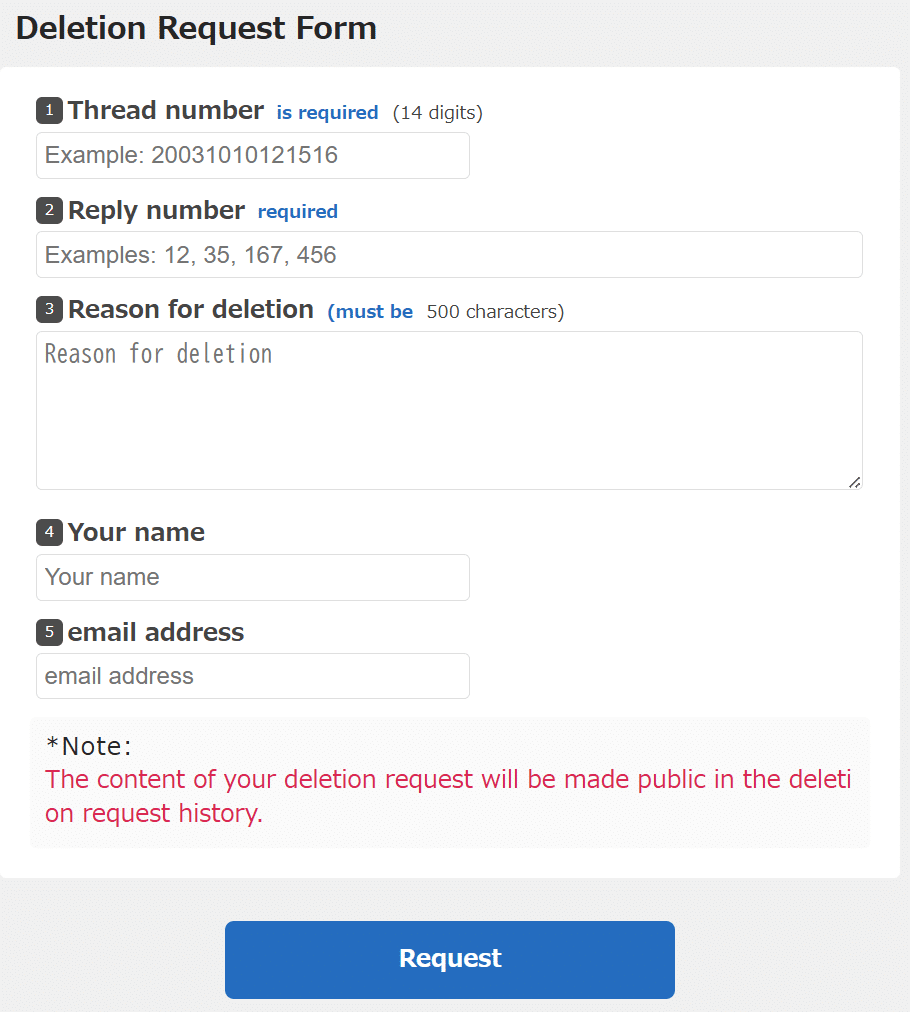
In the reason for removal, describe how the post violates the guidelines in 500 characters or fewer.
The requests are generally reviewed within 96 hours. Because there is no dedicated point of contact for checking the result, you can assume that the removal request has been denied if the review is still public after more than a week.
Please note that removal decisions are made by volunteers. As a result, even if a post clearly violatates the terms of use, it may slip through the monitoring check due to this reason.
In addition, the content of the removal request will be published on the website under “Removal Request History.” If you are not careful about how you write on the request form, there is a possibility of secondary damage. It is recommended not to include information that could easily identify the individual concerned.
How to Legally Request the Removal of Posts on Hostlove
Even if a request for removal through Host Love fails, it may still be possible to request the removal of unlawful posts through court proceedings. As explained above, the main legal issues discussed in this matter are defamation and privacy infringement. Such posts may be considered illegal if they infringe an individual’s the right of reputation or privacy.
Removal due to Defamation
Defamation refers to damaging reputation of others or organizations by publicly indicating a certain fact. For example, if someone writes, “The president of XX company is having an affair” or “This shop is a rip-off,” it can damage the reputation of the company or shop, thus constituting behavior that lowers social credibility.
However, it is important to note that if those factual statements are true or if there are justifiable grounds that proves them to be true, the likelihood of defamation being established is low.
In Article 230 of the Japanese Penal Code, defamation is stated as: “A person who defames another person by making allegations in public, regardless of whether such facts are true or false, is punished by imprisonment or imprisonment without work for not more than 3 years or a fine of not more than 500,000 yen.” In addition to potential criminal liability, it may also be possible to request removal through civil proceedings.
For more information about the legal requirements for defamation, please see the following article.
https://monolith.law/reputation/defamation[ja]
Invasion of Privacy
If personal information, such as address and name, is posted without permission, it is possible to claim an invasion of privacy. If information related to private life that has not been disclosed to third parties are exposed to the public and the victim feels distressed or emotional discomfort, there is a high possibility that an invasion of privacy may be recognized.
The key difference from defamation is that an invasion of privacy can be recognized even if the disclosed information is true. Invasion of privacy is not listed in the Penal Code and is generally treated as a civil matter; however, it can be subject to damages, so it is possible to request removal on the grounds of invasion of privacy. The right to privacy is a right that has been recognized relatively recently, so it is not listed in the law, including the Civil Code. It has developed primarily through court precedents.
For more information about the legal requirements for establishing invasion of privacy, please see the following article.
https://monolith.law/reputation/privacy-invasion[ja]
Requesting Removal Through the Courts: Provisional Disposition
When it comes to legal procedures through the courts, many may imagine initiating a lawsuit. However, in the case of requesting the removal of online reviews, a procedure called provisional disposition, rather than a lawsuit, is used. In simple terms, provisional disposition is a procedure similar to swift courts.
If the court acknowledges that there is a basis for the request, it may issue a removal order to the administrator of the website. Although provisional in nature, it is still an order from the court, so in most cases, the website will comply with the removal. Provisional disposition is a procedure often used in practice because it allows for a quicker response compared to a lawsuit.
However, to obtain a provisional disposition, it is necessary to legally assert and prove that the post is unlawful, just like in a lawsuit. You need to convince the court by arguing and presenting evidence about what rights have been infringed and how the post infringes them. Making such arguments can be difficult without legal knowledge, so it is recommended to consult with a lawyer who is experienced in online defamation.
https://monolith.law/reputation/provisional-disposition[ja]
How to Identify the Poster of a Host Love Message
In some cases, you may wish to claim damages from the person who made the post. Let’s say that a photo of your face was posted online and your daily life has been disrupted as a result. Through the court procedures, it may be possible to not only have the post deleted but also to identify the poster, which are necessary to claim damages.
In such cases, the procedure includes: requesting the website operator to disclose the IP address, identifying the internet service provider, and then seeking disclosure of the sender’s information from that provider. Website administrators often do not hold the poster’s personal information, and this applies to bulletin board-style websites that can be used without registration, including Host Love. For this reason, it is necessary to obtain the IP address first.
https://monolith.law/reputation/male-hostclub-specific[ja]
Summary
There are two main ways to seek the removal of posts from Host Love: claiming a violation of the terms of use and directly requesting removal on the website; and claiming illegality and request removal through the court proceedings. When requesting removal through the website, you can submit the request by filling in the necessary information on the inquiry form. However, because the removal process is handled by volunteers, there is no guarantee that the post will be deleted.
If you are unable to remove the post on your own, we recommend consulting a lawyer to assess the situation and determine whether court proceedings may be appropriate.

Category: Internet
Related Articles


A Comprehensive Guide on How to Delete Google Suggestions and Understand Their Display Mechanism
Internet

Explaining the Key Points of the 2020 Amendment to the Japanese Copyright Law: To What Extent is.
Internet

What is the Method of Writing a Request for Transmission Prevention Measures under the Japanese .
Internet


Explaining Illustration Tracing and Copyright Law Amidst the Frequent Plagiarism Controversies
Internet